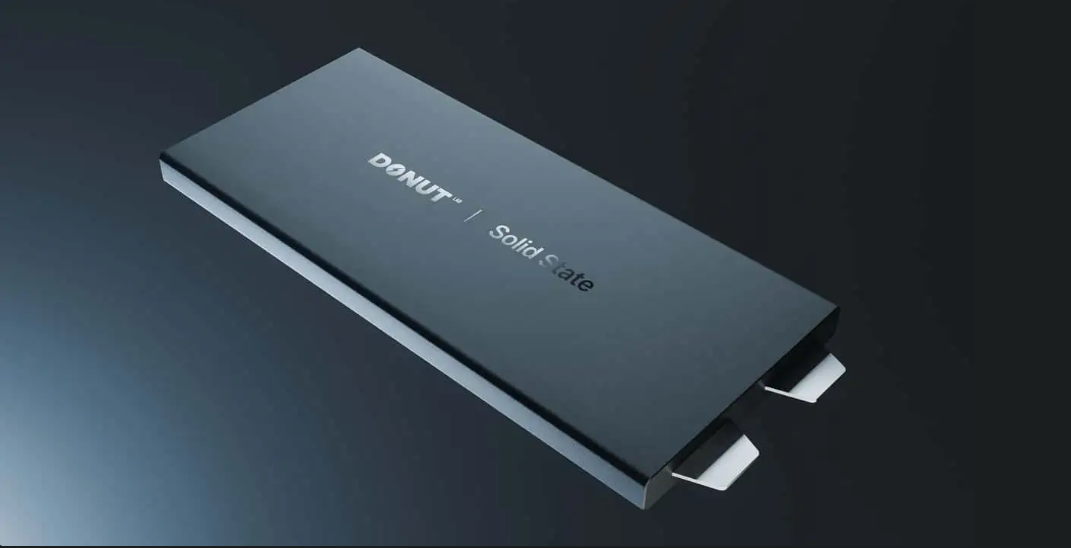

Finnish startup Donut Lab has released results from the second independent test of its “Donut Solid State Battery V1,” conducted by Finland’s state-backed VTT Technical Research Centre. Published on March 2, 2026, as part of the company’s “I Donut Believe” transparency campaign, this test focused on high-temperature discharge performance — and confirmed results that conventional lithium-ion cells cannot sustain without degradation or safety risks. The bigger claims remain on a fixed testing schedule, not abandoned.
What This Test Measured
The report, numbered VTT-CR-00124-26, was authored by research team leader Ari Hentunen, reviewed by research professor Mikko Pihlatie, and approved on March 2, 2026 by Petri Söderena, VTT’s Vice President of Transport Technologies. Battery Technology
VTT tested a Donut Lab cell with a nominal capacity of 26 Ah and a nominal energy content of 94 Wh in a Weiss LabEvent T/110/40/3 climate chamber using a PEC ACT0550 cell tester. Unlike the first test, VTT placed a 2.4-kilogram steel weight on the cell to apply mechanical pressure. Interesting Engineering Three charge-discharge cycles were run across three temperatures:
- At room temperature (+20°C), the cell delivered 24.9 Ah at a 1C rate (24 A) — about 4% below the stated 26 Ah nominal. Electrek
- At 80°C, the cell was discharged at 24 amperes and delivered 27.5 Ah — 110.5% of its room-temperature capacity. After discharge, the cell was recharged normally with no observable changes detected. Interesting Engineering
- At 100°C, the cell achieved 107.1% of its reference discharge capacity at a reduced current of 12 amperes. After discharge, the cell could be charged normally. Interesting Engineering
Such high temperatures would trigger severe degradation and thermal runaway reactions in conventional lithium-ion cells. Geeky Gadgets Donut Lab’s CTO Ville Piippo stated that conventional lithium-ion batteries typically have a maximum operating temperature of around 60 to 70 degrees Celsius, and that high temperatures can accelerate reactions inside the cell, in the worst case significantly increasing the risk of thermal runaway. He said the Donut battery starts from a fundamentally different position as it contains no flammable liquid electrolytes. Interesting Engineering
One Notable Incident
VTT noted in its report that the pouch cell labelled DL2 lost its vacuum after the 100-degree test. Donut Lab presents this as a success, stating: “The battery and its active materials remained fully functional even after the outer cell casing lost its vacuum at 100 degrees.” Interesting Engineering
What Skeptics Say — Specifically About This Second Test
1. The pouch losing vacuum is a durability concern. The pouch losing vacuum at 100°C raises questions about long-term durability at that extreme. Electrive A cell casing breach under operational conditions is not a standard pass result in the battery industry, regardless of how the company frames it.
2. VTT still has not confirmed the cell is solid-state. VTT does not confirm whether the tested cell is indeed a solid-state cell without lithium. As in the first report, the second states that VTT conducted tests on an “energy storage device provided by the customer, identified by the customer as a solid-state battery cell.” After the first test series was published, several experts publicly challenged the claim that the cell operates without lithium. Specialists pointed out that the charging curve and additional data indicated it could in fact be a lithium-ion cell. Joachim Sann, a battery researcher at the University of Giessen, criticised elements of the test procedures defined by Donut Lab, including the approach used to determine capacity and the selected temperature levels. Engineerlive
3. The cell’s weight has never been disclosed. The VTT report completely omits the cell’s weight and physical dimensions. Without knowing this information, verifying its energy density is impossible. Electrek The VTT report lists the cell as 26 Ah at 3.6 V nominal — that is 94 Wh. To hit 400 Wh/kg, the cell would need to weigh approximately 235 grams. Electrek That figure has not been independently confirmed by any party.
4. Donut Lab is proving the easier claims first. The pattern is clear: Donut Lab is proving the easier claims first. Fast charging and high-temperature tolerance, while impressive, are the least controversial aspects of what the company announced at CES. The claims that drew the harshest criticism from the battery industry — 400 Wh/kg energy density and 100,000-cycle life — remain completely untested. Electrive That said, this follows a publicly announced schedule (see below), not an evasion.
5. The combination of all claimed specs defies known chemistry. Factorial Energy’s solid-state cells validated by Stellantis achieved 375 Wh/kg, and FAW’s semi-solid-state cells claim over 500 Wh/kg — but neither of those also claims 11C charging and 100,000 cycles simultaneously. The combination of all three is what experts say defies known battery chemistry. Svolt Energy’s chairman Yang Hongxin told Chinese media that the battery simply doesn’t exist, calling all the parameters contradictory, and stating that any technician with basic knowledge would recognize it as a scam. Electrek
6. The broader industry context deepens skepticism. The biggest established players in solid-state batteries — Toyota, Samsung SDI, CATL, and BYD — are all targeting 2027 or later for initial production of their own solid-state cells. None of them claim to have a production-ready cell matching all of Donut Lab’s specifications simultaneously. Electrive As Electrek noted, “it’s hard to imagine that a small outfit in Finland quietly cracked the solid-state nut when well-financed giants have not been able to deliver anything remotely close to these KPIs after billions spent on R&D.” Electrive
The Untested Claims Are Scheduled — Not Abandoned
The remaining claims are part of a published four-stage testing plan. Stage 2, expected mid-March 2026, covers energy density, including the 400 Wh/kg claim. Stage 3, expected late March 2026, tests cold weather performance at -30°C. Stage 4, expected in April 2026, uses accelerated protocols to evaluate the 100,000-cycle assertion. Battery Technology
A third round of testing is planned, focusing on the battery’s performance at extremely low temperatures, specifically -30°C. This phase of testing could provide valuable insights into the battery’s chemistry and its ability to operate across a broad temperature range. I Donut Believe
The Delivery Timeline
The original commitment was bikes delivered in Q1 2026. That picture has since become more complicated. Verge Motorcycles CEO Tuomo Lehtimäki told InsideEVs: “First orders received last year for Verge Motorcycles will start in Q1 as previously mentioned. New U.S. orders received now can expect a bike delivery in Q4. There is a queue and orders made last year will be delivered first. Verge Motorcycles deliveries will start in late March.” Electrek However, the Finnish newspaper Kauppalehti quoted Lehtimäki as saying orders currently go well into 2027, with only Finland and Estonia potentially seeing deliveries by the end of 2026. Interesting Engineering Around 350 bikes are planned for the full year. Interesting Engineering
For now, two VTT tests confirm that the cell fast-charges and handles extreme heat better than conventional lithium-ion. Whether it is truly solid-state, whether it weighs 235 grams, whether it survives 100,000 cycles, and whether it performs at -30°C will all be answered by VTT in the coming weeks — on the record, with data.