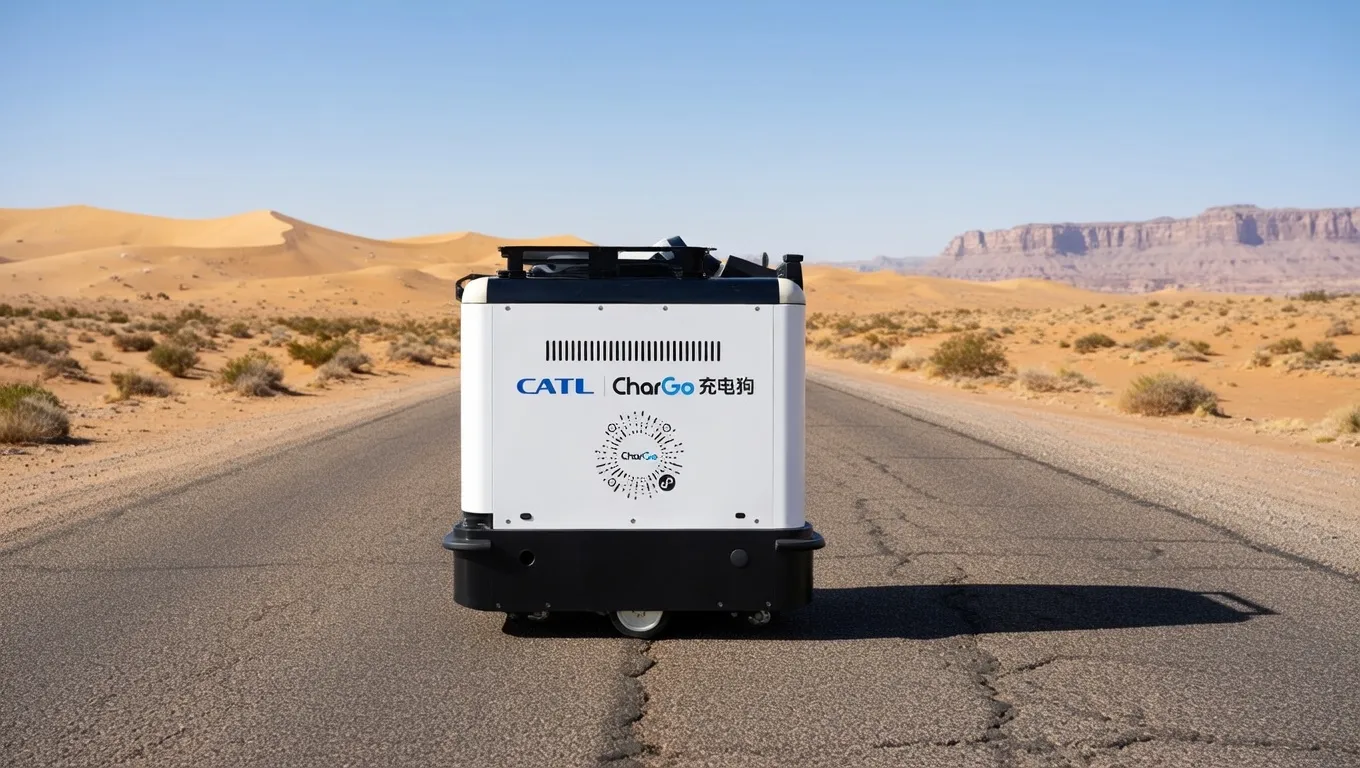

China’s mobile EV charging market has moved past the pilot phase. Two companies are now deploying at commercial scale, and one of them has confirmed European entry plans for the second half of 2026.
The Hardware
Eraergy’s Energy Tank unit is available in 30, 100, and 200 kWh configurations, with up to 120 kW discharge power. Deployments target older residential complexes, hotels, and logistics yards. A vehicle at 10% state of charge can be replenished in 40 to 60 minutes. Residents summon units via phone app. Eraergy is currently targeting SAE L4 autonomy for closed environments.
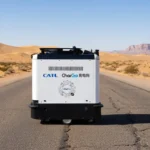
CATL’s CharGo subsidiary operates a comparable product and has deployed over 100 units to date. The company plans to scale to between 5,000 and 15,000 units across 100 Chinese cities within two years. SF Express already uses CharGo units for logistics vehicles during loading intervals. CharGo’s CEO projects that robotic chargers will handle 20% of Chinese EV charging by 2030.
Why the Use Case Matters
The residential deployment context is not incidental. Both companies are addressing a structural gap: older buildings cannot be retrofitted with fixed high-power charging infrastructure at reasonable cost or within planning frameworks. Mobile robots bypass the fixed infrastructure problem entirely. The charging point comes to the vehicle, not the other way around.
This is also why the European entry is significant. The EU’s AFIR regulation mandated high-power charging points along TEN-T transport corridors, a requirement now substantially complete. AFIR does not address residential or hotel charging in older buildings. That gap is precisely the segment CharGo has confirmed it is targeting for its H2 2026 European rollout.
A Different Competitive Dimension
CharGo’s European entry should be read separately from CATL’s battery supply agreements with European OEMs. This is not battery chemistry or vehicle manufacturing. This is CATL moving downstream into the service layer of the European EV market, competing in infrastructure rather than components.
There is no specific EU regulatory framework for autonomous mobile EV chargers. CharGo’s European rollout will require navigation of individual member-state electrical safety and public liability regulations, which vary considerably. That is a market entry constraint, not a barrier to entry.
Who Should Be Watching
Whether mobile charging robots find the same traction in European markets as they have in China may depend on how quickly member states move to create consistent regulatory conditions for autonomous charging infrastructure.