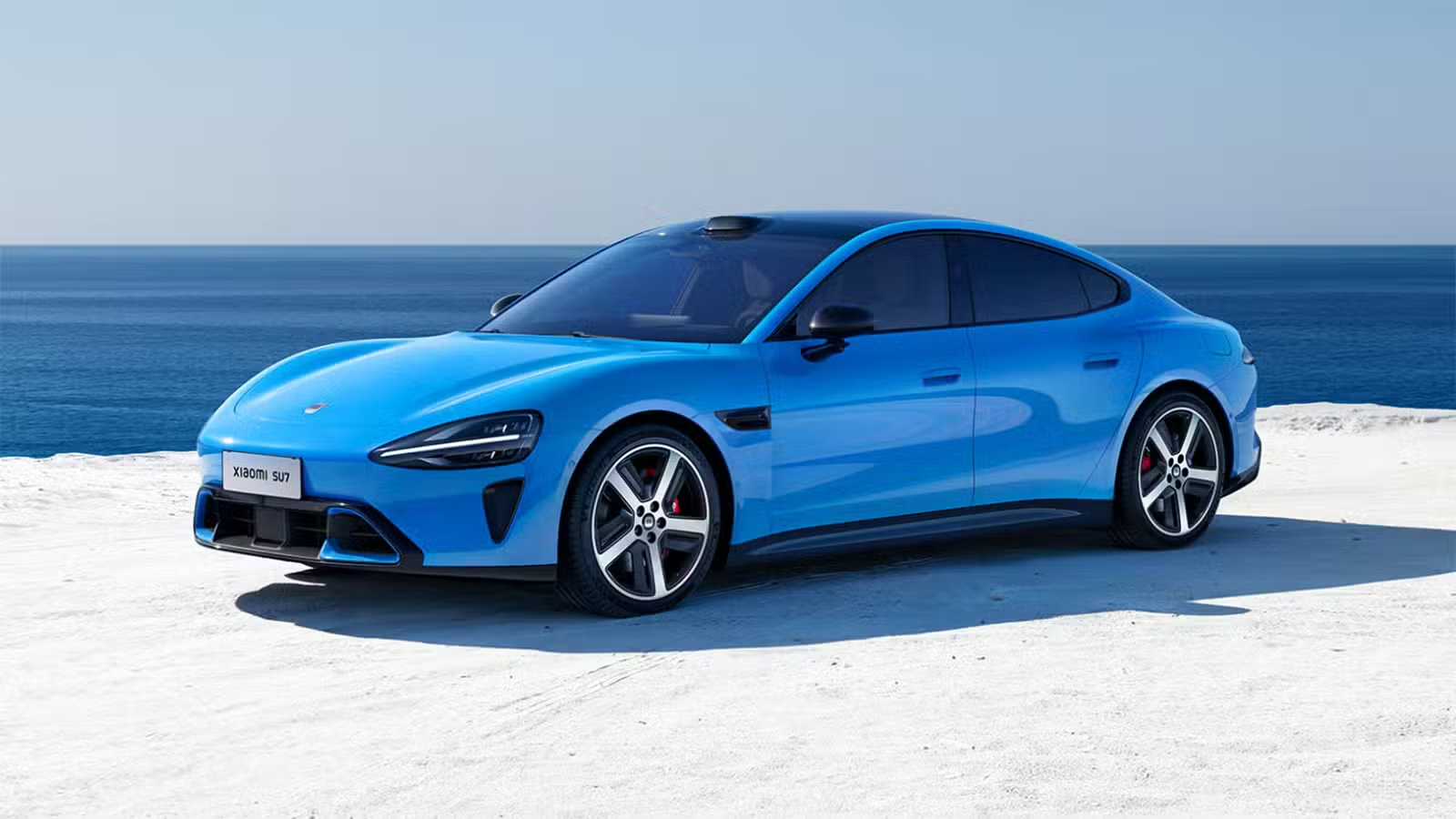

Xiaomi launched the second-generation SU7 in China with Nvidia Thor compute, LiDAR, and 4D radar standard across all trims, including the entry model at approximately €27,900. No European mass-market sedan currently ships this level of hardware at any price point. European entry pricing, when it comes, is estimated at €35,000 to €42,000 under the price undertaking framework. The compute gap will still be there.
What Happened
On March 18, 2026, Xiaomi officially launched the second-generation SU7 sedan in China across three trims. The standard model is priced at 219,900 yuan (approximately €27,900) with a 73 kWh battery and 720 km CLTC range. The Pro model sits at 249,900 yuan (approximately €31,700) with a 96.3 kWh pack and 902 km CLTC range. The Max model is priced at 303,900 yuan (approximately €38,600), carries a 101.7 kWh battery, dual-motor AWD, 0-100 km/h in 3.08 seconds, and a claimed 670 km range recovery in 15 minutes via an 800V silicon carbide platform.
The market response was immediate, with 15,000 units claimed in only 34 minutes. To finalize a booking, customers must provide a 5,000 yuan (725 USD) deposit. Because the window for order modifications is very brie, concluding on March 22, it is clear that Xiaomi is prioritizing a rapid transition into production to fulfill these orders as quickly as possible.(updated 20/3)
All three trims receive LiDAR, Nvidia Thor compute at 700 TOPS, 4D millimeter-wave radar, and the XLA cognitive model, which integrates assisted driving and robotics AI in a single inference architecture. The vehicle recorded over 15,000 locked-in orders in 34 minutes. Xiaomi targets 550,000 total deliveries in 2026 across the SU7 and the upcoming YU7 SUV. No European market entry date has been announced.
What It Means
The specification is not the headline. The price is.
The Nvidia Thor chip at 700 TOPS is standard across all trims, including the €27,900 entry model. No European mass-market sedan currently ships this level of computing hardware across all trims at any price point. The 15-minute 670 km charge claim on the Max implies peak charging rates well above 300 kW. CLTC figures typically carry a 30 to 35 percent reduction when converted to WLTP, bringing the Max’s real-world European range to approximately 540 to 580 km. The XLA model’s integration of ADAS and robotics AI in a shared inference architecture is not a conventional feature addition. Whether it produces meaningful real-world driving improvements is not verifiable from the launch event alone, but the underlying silicon platform is capable of supporting both workloads simultaneously.
The European pricing picture is bounded by the price undertaking framework in force since January 12, 2026. Analysis places Xiaomi’s likely European entry price in the €35,000 to €42,000 range, depending on the accepted undertaking level. That would position the SU7 alongside or below the Tesla Model 3 in Germany, with materially more computing hardware as standard equipment.
One execution risk is documented: February 2026 deliveries dropped 47 percent during the model transition. Sustaining 550,000 annual deliveries across two models while managing a generational changeover is a supply and logistics challenge that the launch event does not resolve.
Whether Xiaomi’s cost structure and technology integration can hold this feature-to-price relationship through European homologation, and what that means for mid-market segment pricing across European OEMs, remains an open question this generation of the SU7 has made harder to defer.