

Takeaways:
- BYD’s automotive gross margin fell to 17.74 percent in 2025, a three-year low, as domestic price wars compressed profitability.
- Hungary plant mass production is delayed, meaning BYD’s European sales will carry the full 27 percent combined import duty longer than previously expected.
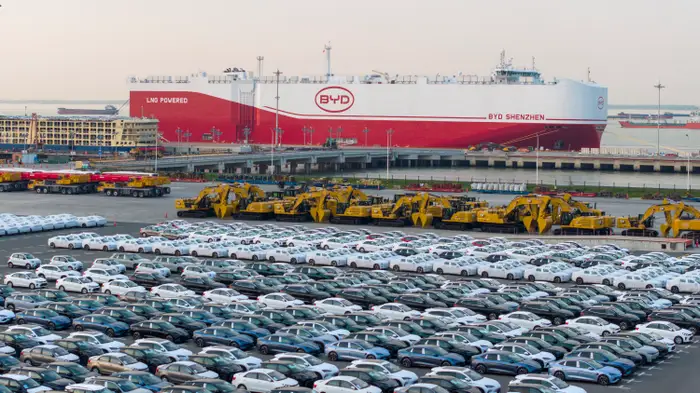
BYD has signaled confidence in reaching 1.5 million overseas vehicle sales in 2026, a 15 percent increase from its January target, as the company faces its first annual net profit decline in four years. According to Bloomberg, BYD management communicated the revised forecast to analysts on March 30 during a briefing following the release of worse-than-expected fourth-quarter earnings .
Why BYD Is Raising 2026 Export Targets
According to BYD’s 2025 annual report released March 27, net profit attributable to shareholders fell 19 percent year-on-year to RMB 32.62 billion (USD 4.72 billion), missing analyst estimates . Automotive gross margin contracted to 17.74 percent from 19.44 percent, a three-year low, as domestic price wars intensified. Chairman Wang Chuanfu described the Chinese market as undergoing a “brutal knockout stage” in a shareholder letter .
February 2026 sales data showed overseas units exceeded domestic deliveries for the first time, with 100,151 vehicles sold abroad versus 90,000 in China . Citigroup estimates that BYD’s domestic car sales turned unprofitable in the first quarter, making the company rely entirely on exports for profitability in its core auto business .
When Hungary Production Arrives
BYD’s Hungary plant, intended to bypass the EU’s 27 percent combined import duty on Chinese-built EVs, is not yet at series production. According to TMTPost, BYD has delayed mass production at the Hungarian facility and plans to operate it below capacity for at least two years, while accelerating its production timeline in Turkey . JPMorgan noted that BYD’s global factories, including Hungary, Indonesia, Malaysia, and Brazil, will gradually start production from the second quarter of 2026 .
The delay extends the period during which BYD’s European sales carry the full 17 percent anti-subsidy duty plus 10 percent standard tariff, compressing margins even as overseas volume becomes structurally necessary.
If BYD’s Hungary plant operates below capacity through 2027 while domestic margins remain compressed, does the company’s European pricing strategy prioritize volume recovery over margin discipline until local production scales?
Source: Yahoo