
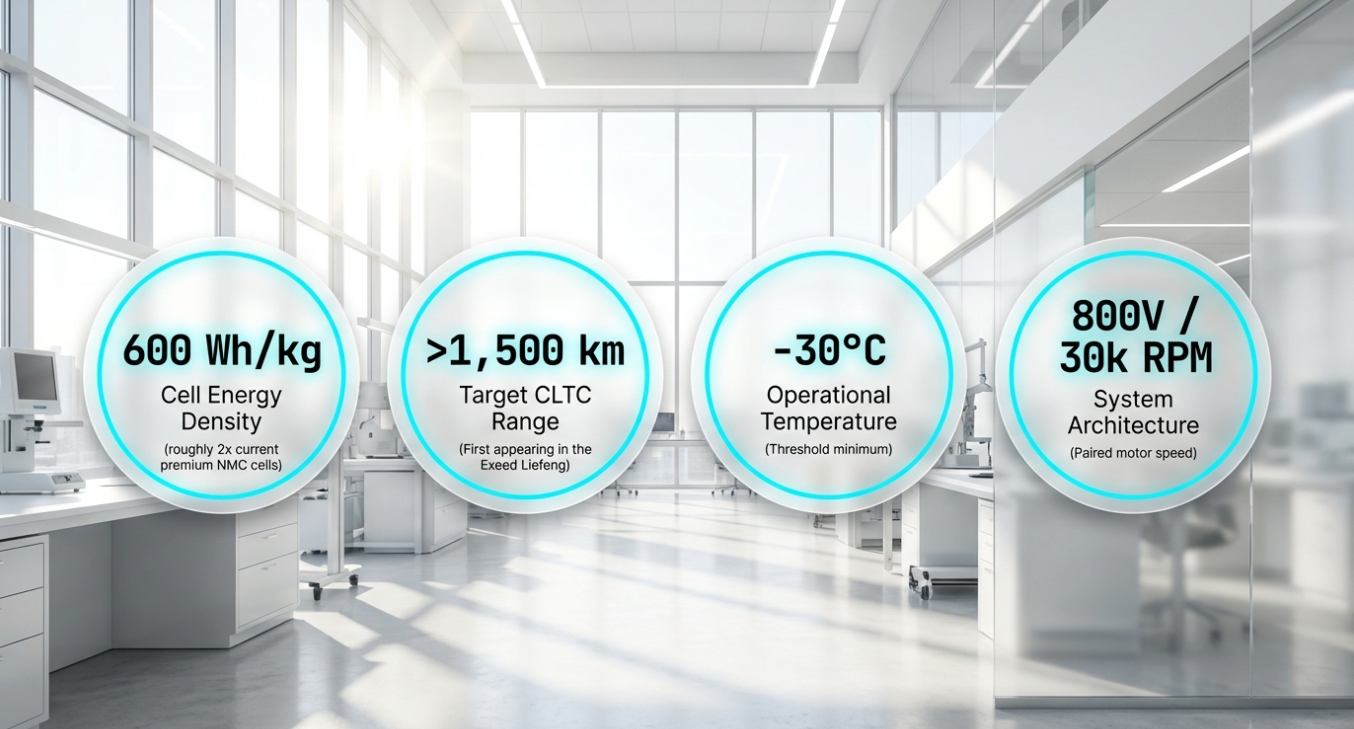
Tomorrow, Chinese automaker Chery will host a “Battery Night” event to unveil its Rhino S all-solid-state battery system, a technology it claims will deliver a cell energy density of 600 Wh/kg. For a sector accustomed to incremental gains, the figure is striking: it roughly doubles the energy density of current premium nickel manganese cobalt (NMC) cells in production.
The timing of the announcement is strategic. Chery, which sold over 100,000 vehicles in Europe in 2025 through its Omoda and Jaecoo (Lepas coming soon) brands, is currently navigating the EU’s price undertaking framework. If the technology matures as stated, it could provide the automaker with a significant lever to push into the mid-premium segment where European margins are thickest, just as its European volume scales up.
The Technical Claims
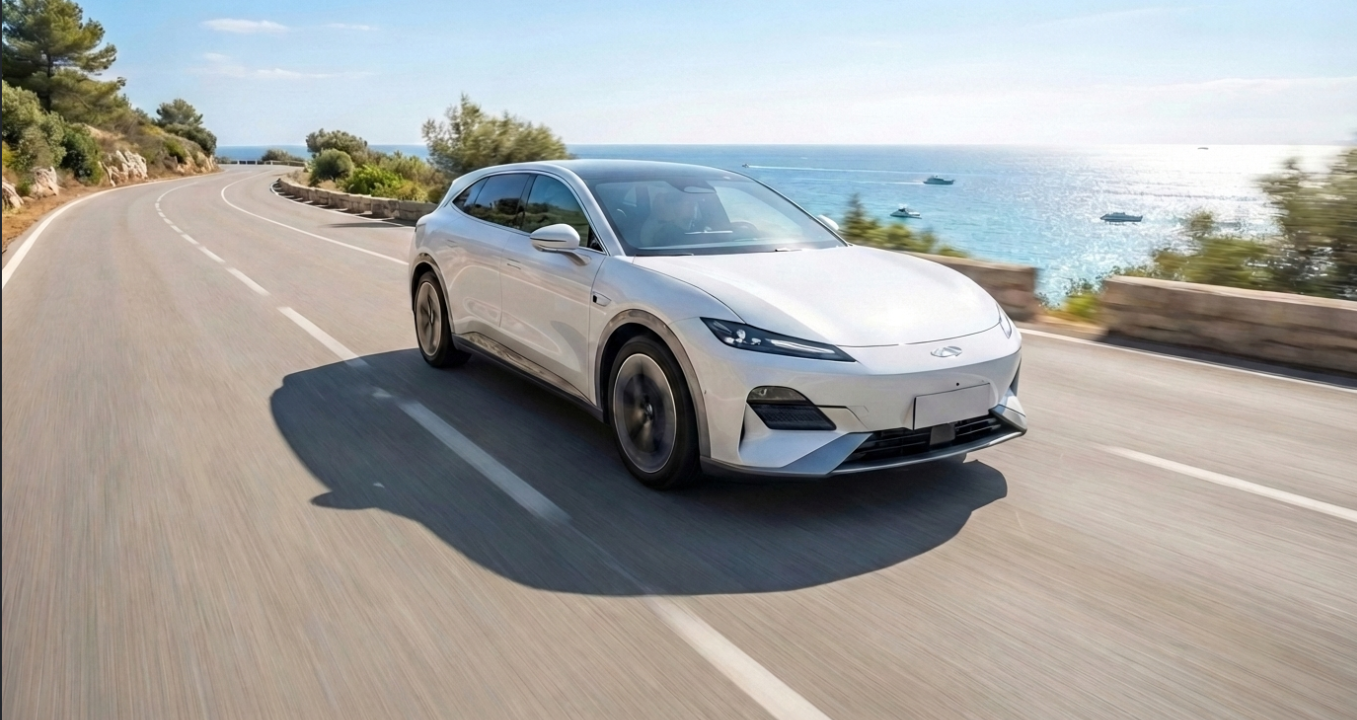
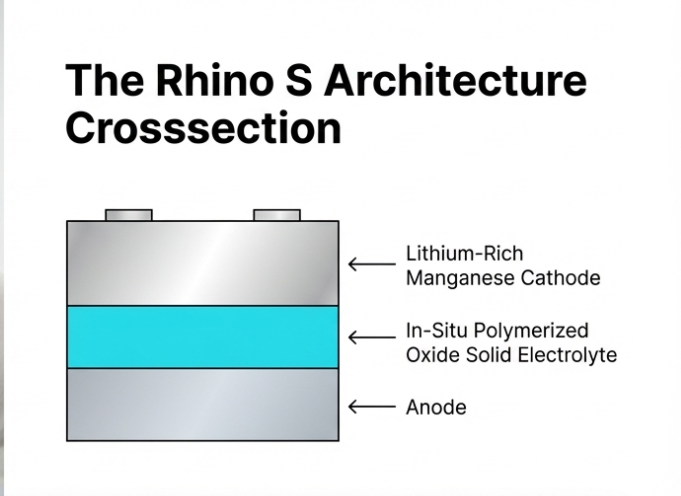
Developed by Chery’s Solid-State Battery Research Institute, the Rhino S module utilizes an oxide-based, in-situ polymerized solid electrolyte paired with a lithium-rich manganese cathode. At the cell level, Chery claims 600 Wh/kg. At the vehicle level, the battery will first appear in the Exeed Liefeng shooting brake, which targets a range of over 1,500 km on China’s CLTC cycle.
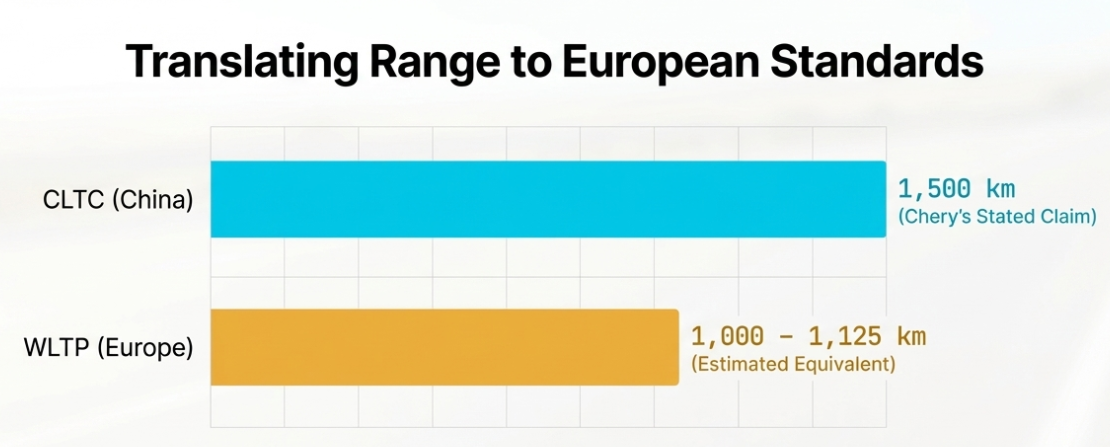
For European context, the CLTC cycle is generally 25–35% more generous than the WLTP standard used across the EU. A 1,500 km CLTC claim would translate to an approximate WLTP-equivalent range of 1,000 to 1,125 km. The current long-range benchmark in Europe is the Mercedes EQS, which tops out at around 820 km WLTP. Chery’s projected figure would clear that by roughly 200 to 300 km. The system also maintains operability at -30°C and is built on an 800V architecture paired with a 30,000 rpm motor.
Timeline vs. Reality
Chery’s roadmap is aggressive. The company plans to achieve 0.5 GWh pilot line production and pack sample completion in 2026. In 2027, Chery will officially launch solid-state battery vehicle demonstration work, driving the technology from production lines to real-vehicle validation. The most recent pre-event briefing from Chery itself states that on-vehicle verifications are planned to begin in 2027. Earlier January 2026 reports had placed a controlled fleet pilot in 2026; the current picture is that 2026 is a production line milestone, and vehicles follow in 2027.
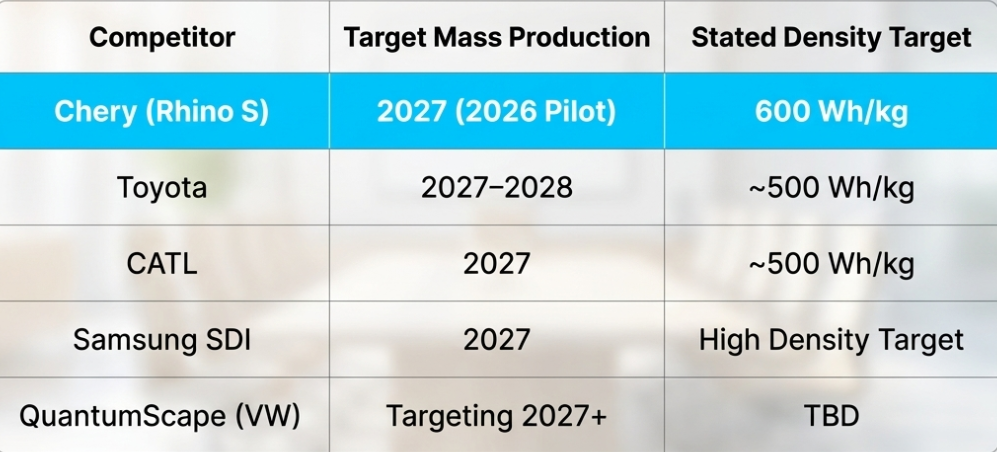
Toyota, CATL, Samsung SDI, and Volkswagen-backed QuantumScape are all targeting 2027 or 2028 for their initial solid-state production runs. Chery is aiming at the same finishing line, but it is a late entrant making an outsized claim to catch companies that have spent years and billions on this exact technology. That Chery’s 600 Wh/kg figure, if validated, actually exceeds the 500 Wh/kg targets announced by some of those competitors is interesting. It does not change the weight of the credibility gap.
However, the announcement requires careful parsing. The 600 Wh/kg figure is strictly at the cell level; system-level pack density will be substantially lower. Mass production cost curves for solid-state cells remain an unsolved equation across the entire industry, and Chery has not disclosed production economics. The 2027 vehicle demonstration refers to controlled validation, not consumer sales.
The European Strategic Lens
For European observers, the significance lies in the convergence of timelines. Chery’s European market scaling window aligns directly with its solid-state production target. If the company meets its 2027 mass production goal, vehicles equipped with the Rhino S battery could reach European showrooms as early as 2028.
That entry would occur under the current trade framework. Since October 2024, China-built Chery exports face a combined duty of 30.7%, a 20.7% countervailing duty applied to all other cooperating companies, plus the 10% Most Favored Nation rate. Chery is advancing a joint venture manufacturing plant in Spain, at the former Nissan facility in Barcelona, with Chery-branded production now planned for 2026 after repeated delays from the original 2024 target. Ebro-branded vehicles are already being assembled at the site. Local final assembly would change the tariff calculation entirely.
The company has already demonstrated nail-penetration and power-drill safety tests without combustion — a key hurdle for solid-state acceptance. Regulatory complexity remains. Under the EU Battery Regulation, carbon footprint declarations for EV batteries became mandatory from 18 February 2025, requiring third-party verified lifecycle emissions data per battery model and manufacturing plant, made publicly accessible online. Oxide-based solid-state cells present specific challenges here: the sintering process required to manufacture oxide electrolytes is highly energy-intensive, which means the carbon profile of Rhino S cells will face scrutiny well before any range figure matters to a European buyer.
What to Watch
Tomorrow’s event should be monitored for engineering specifics beyond the headline range figure. Details on oxide versus sulfide electrolyte composition, anode chemistry, and any confirmed supply agreements will separate a genuine industrial roadmap from a marketing preview.
Chery has never led on battery technology. That may be changing.
Update 18/3
Chery is backing its solid-state ambitions with a parallel infrastructure play, announcing plans to roll out a network of Xunlong ultra-fast charging stations equipped with V2G capabilities. The initial phase will see 100 stations deployed across ten cities, scaling to over 20,000 by 2029 with next-generation silicon carbide components promising system efficiency above 96.5%.
The announcement lands on the back of robust 2025 financial results—net profit surged 34.6% to ¥19.02 billion (103,620,960$) on record deliveries of 2.63 million vehicles, providing both capital and commercial momentum. The timing also frames Chery’s technology push squarely against rival BYD, which unveiled its second-generation Blade Battery just 13 days prior, alongside plans for 20,000 flash charging stations in China by year-end.