
Takeaways
- The Galaxy A7 EV is built on Geely‘s GEA platform with the ZCU 3.0 zone control unit architecture, which first entered mass production in this model and has since expanded to nine Lynk & Co and Galaxy models.
- No European launch or pricing has been announced; the technology is likely to appear in future Lynk & Co and Zeekr derivatives destined for European markets.
Geely Galaxy A7 EV Images Released as Flagship of GEA Platform Ahead of April Launch
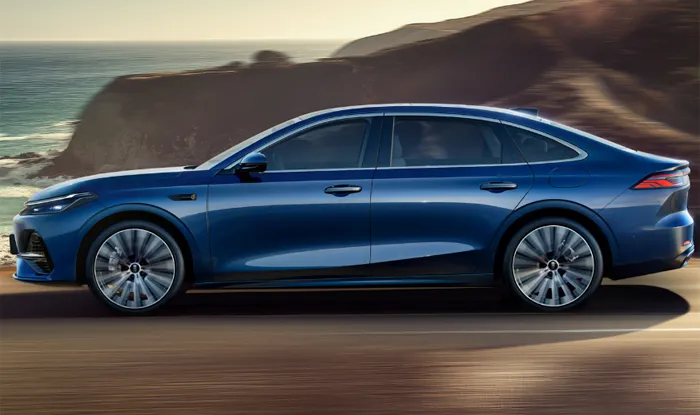
According to multiple Chinese media reports dated 7 April 2026, Geely has released official images of the Galaxy A7 EV, the pure electric variant of its midsize sedan. The vehicle is built on Geely’s Global Intelligent New Energy Architecture (GEA). The A7 EV measures 4,935 mm in length, 1,905 mm in width, and 1,500 mm in height, with a wheelbase of 2,845 mm.
These dimensions make it slightly longer and taller than the plug in hybrid version. The EV variant features a closed front grille design, distinguishing it visually from the PHEV.
Powertrain and Battery Specifications
The Galaxy A7 EV uses a front mounted single electric motor producing 160 kW (approximately 215 horsepower). Two lithium iron phosphate (LFP) battery packs are available. A 49.52 kWh pack delivers 470 km of CLTC range, while a 58.05 kWh pack provides 550 km of CLTC range.
For European readers, CLTC figures typically read 15 to 20 percent higher than WLTP equivalents. The vehicle supports DC fast charging, replenishing from 10 to 80 percent in 20 minutes. Energy consumption is rated at 11.4 kWh per 100 km.
Platform and Technology Sharing
The GEA architecture is central to Geely’s strategy. The ZCU 3.0 zone control unit platform, co developed with Jingwei Hirain, first entered mass production in the Galaxy A7 in July 2025. Within six months, it expanded to the Galaxy M9 and Lynk & Co series across nine models.
The platform consolidates body comfort and climate control functions into a single controller, reducing wiring complexity. This architecture supports functional safety levels from ASIL B to ASIL D.
Interior and Smart Cockpit
The A7 EV is equipped with the Galaxy Flyme Auto 2 smart cockpit, featuring a 14.6 inch central touchscreen (15.4 inches in higher trims), a 16 speaker Flyme Sound system, and 50 watt wireless charging. The system supports AI voice interaction, four zone voice recognition, and multiple smartphone connectivity options including CarPlay.
European Market Implications
The A7 EV has no announced European launch. The PHEV variant currently sells in China for 89,800 to 125,800 yuan (approximately €11,500 to €16,100).
For European readers, the open question is whether the GEA architecture and ZCU 3.0 platform technologies demonstrated in the A7 EV will appear in future Lynk & Co and Zeekr models destined for European showrooms within the next two to three model cycles.