
Takeaways
- FSD Supervised approval in the Netherlands on 10 April 2026 excludes all HW3 vehicles; owners who paid €5,300‑€7,500 cannot access the system they were promised.
- A collective claim website launched 14 April has gathered over 500 owners across Europe; two formal notices have been rejected, with potential legal action under Dutch law now being prepared.
A Dutch Tesla owner has launched a collective claim website targeting European customers whose older vehicles cannot access Full Self-Driving (FSD) Supervised, following the system’s first regulatory approval in the European Union. Mischa Sigtermans, a 2019 Model 3 buyer who paid €6,400 for the FSD package, started hw3claim.nl on 14 April 2026. The site aims to bundle owners of Hardware 3 (HW3) vehicles who either want a negotiated resolution with Tesla or pursue a legal claim. Within its first 24 hours, the initiative gathered over 500 owners and 400 vehicles, with registrations now open across multiple EU countries including Germany, France and Belgium.
RDW Approval Excludes HW3 Hardware
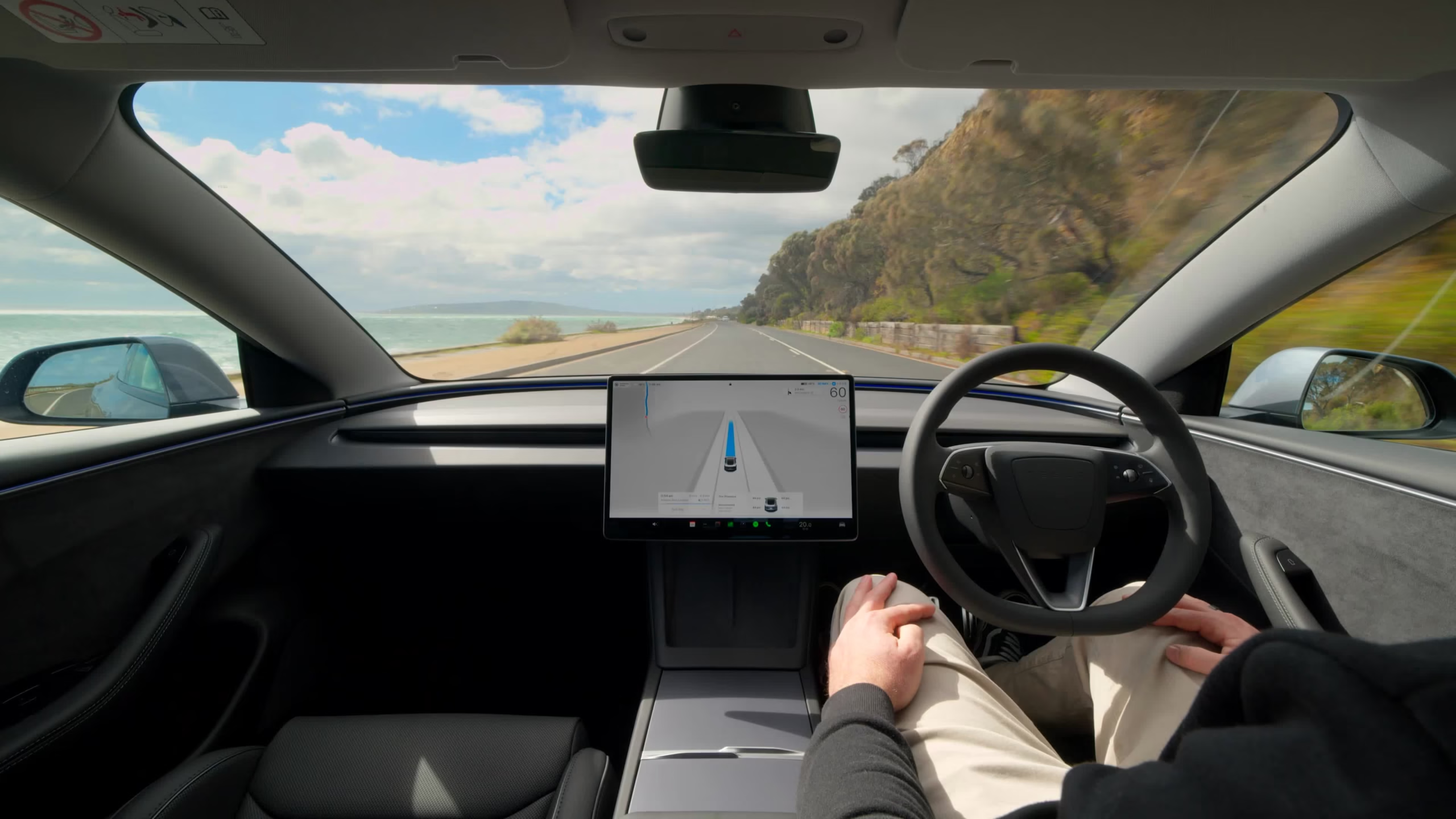
The Dutch vehicle authority RDW granted Tesla type approval for FSD Supervised under UN R-171 on 10 April 2026, after more than 18 months of testing covering over 1.6 million kilometres on EU roads. This approval, which is currently valid only in the Netherlands, marked the first full type approval for FSD anywhere in the European Union. However, the approved system runs exclusively on Tesla‘s newer AI4 computer. Cars equipped with HW3, also known as FSD Computer 3.0, receive nothing at launch.
FSD Supervised is a driver assistance system classified under UN R-171 as a Driver Control Assistance System. The driver remains legally responsible and must be able to take over immediately at all times. European buyers who pre-ordered the FSD package paid between €5,300 and €7,500, depending on when they purchased.
Tesla’s Own Words May Be Its Biggest Legal Risk
Tesla has vaguely promised a stripped-down “v14 Lite” version for HW3, expected sometime in the second quarter of 2026. But the company‘s own US patent filing acknowledges that the mathematical workaround required to squeeze a modern FSD model onto HW3 can render the system “inoperable” for perception units of an autonomous driving system.
Tesla‘s paper trail is extensive. On the Q4 2024 earnings call, CEO Elon Musk admitted that “we will need to replace all HW3 computers in vehicles where FSD was purchased,” calling the situation “painful and difficult”. Tesla VP of AI Ashok Elluswamy acknowledged on 21 August 2024 that HW3 runs a “relatively smaller model” than AI4 with workarounds to emulate operations that run natively on AI4. Roughly 4 million vehicles shipped with HW3, and hundreds of thousands of those owners paid for FSD. Fifteen months after Musk‘s earnings call admission, Tesla still has no concrete plan for HW3 owners, no hardware retrofit program, no refund policy, and no timeline.
Precedent from Australia
This is not Tesla‘s first legal confrontation over HW3. In October 2025, thousands of Tesla owners joined a class-action lawsuit in Australia alleging the company misrepresented FSD and ADAS capabilities. That action was directly triggered by Musk’s HW3 admission. Europe presents a meaningfully tougher legal environment than the United States. EU consumer law gives buyers strong rights around conformity with what was advertised at point of sale, and the Netherlands, Germany and France all have mature collective-redress frameworks.
Two formal notices have already been sent to Tesla, both rejected. The group is now preparing for potential collective legal action or a mass damage settlement under Dutch law as FSD begins its wider rollout across the European Union.
The open question is whether the hw3claim initiative will expand into a formal class action across multiple EU jurisdictions, and whether the precedent established in Dutch courts will reshape how every OEM that markets forward-looking software capabilities at point of sale treats its European customer base.